
Your Essential Formula Feeding Guide


How much should baby eat? Spoiler alert: every baby is different.
Knowing just how much formula your baby needs will depend on their age, weight, and appetite.
And when your baby eats solids, the amount changes again.
To help you figure out the answer, we’ve pulled together some infant feeding guidelines plus handy tips for formula feeding.
In this article: 📝
•
How much formula for newborns? Follow their lead
•
So, how much formula does a baby need?
•
Formula feeding guidelines — how much should a baby eat?
•
Can you overfeed a formula-fed baby?
How much formula for newborns? Follow their lead
Like breastfed babies, bottle-fed babies know when they’re hungry — and when they’ve had enough.
But the difference between boob and bottle is that, with bottles, you’re in charge of pouring and measuring the formula.
This means having a rough formula feeding guide for each stage of baby’s development can be super handy.
Even though there are several caveats when it comes to the amount of formula your baby will need (e.g. age, weight, appetite), you’ll want to know you’re in the right ballpark.
Of course, the best way forward is to follow their hunger cues and feed to match their appetite.
By all means, keep an eye on the ounces, but don’t obsess over numbers.
The most important thing is that your baby is gaining weight at a healthy rate and wetting and dirtying diapers like a champ.
So, how much formula does a baby need?
How much should a newborn eat? How much should a 5-month-old eat?
For newborns and infants (under 6 months), the rule of thumb for measuring formula is around two and a half ounces per pound of body weight per day.
This means if your baby weighs 10 pounds, they should consume around 25 ounces of formula over a 24-hour period.
This roughly equates to 3 to 4 ounces every four hours.
A few things worth keeping in mind:
- Bigger babies drink more than smaller babies (surprise!).
- Just like your own appetite, your baby’s hunger levels can vary from one day to the next.
In short, there’s no magic formula for formula.
Instead, pay attention to what your baby needs.
Common hunger cues, like sucking fingers or hands, nuzzling into your breasts, or turning their head and opening their mouth when you stroke their face (the “rooting reflex”) will hint that they’ve got room for more.
Conversely, if your baby becomes fidgety and/or distracted during feeding, that usually suggests they’ve had their fill.
Formula feeding guidelines — how much should a baby eat?
If you’re still wondering how much formula to give your baby at key stages of development, use this handy formula-feeding chart.
(Remember, this is just a rough guide, and your baby may require more or less).
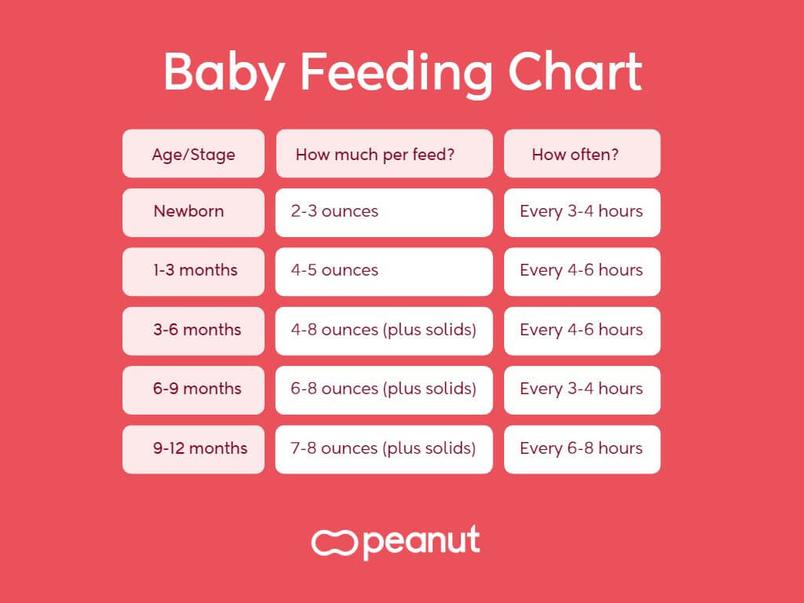
The American Academy of Pediatrics (AAP) suggests limiting their total intake to no more than 32-36 ounces over a 24-hour period.
Can you overfeed a formula-fed baby?
Whether they’re breastfed or bottle-fed, healthy babies tend to drink (and eventually eat) until they’re full and then stop.
However, formula-fed babies can sometimes guzzle more, faster because it’s harder for them to control the milk flow from the bottle, so they don’t realize they’re full until they’ve already eaten more than they need.
Plus, if you misinterpret their fussing, gas, or boredom for hunger, it’s often easier to (unintentionally) pressure them to take an extra feed from a bottle than from the breast.
The good news is, the signs of overfeeding are pretty easy to spot and correct:
- A clear sign of overfeeding is excessive weight gain (i.e., their weight is outpacing their height on the growth chart). This will usually be picked up at one of your regular checkups, which is the best place to discuss your baby’s formula-feeding needs.
- Another hard-to-miss clue is frequent spitting up. If you’re overfilling your baby’s teeny tiny tummy, there’s only one place it’s going to go, and that’s back where it came from.
- Sometimes, loose, foul-smelling baby poop can be the result of overfeeding.
You can avoid giving your baby too much formula by learning their unique hunger and fullness cues.
And if you’re concerned about overfeeding — or if you’re worried your baby isn’t eating enough — speak to your pediatrician.
They’ll help you find the right balance moving forward — maybe paced bottle feeding could work best for you and your baby.
`spacer


Want to find your village?

Scan to Join
Rated 4.4


Trusted by 5M+ women
.png?_wwcv=1371)
Download the Peanut App


